 |
The AI Leader Building a smarter organization with modern tools and literacy |

Decision Intelligence: Shifting Focus From Tasks to Strategy
Conversations about Artificial Intelligence frequently prioritize task automation. While automating repetitive actions increases efficiency, the primary value for leadership resides in decision support. Success requires shifting focus to how AI supports the choices we make.
From Task Automation to Decision Support -Task automation serves as the entry point for AI integration. By handling high-volume work, technology creates a baseline of clean, usable, and vetted information. This operational layer is essential. Reliable data informs every strategic choice.
Reliable decision support depends on a foundation of trusted information. Automation layers verify data integrity by removing human error from collection processes. Once organizations establish this trust, leaders use AI to model outcomes, predict risks, and surface opportunities.
Operations: From Automation to Orchestration- Workflows have shifted from static, rules-based sequences to dynamic networks. Multi-agent ecosystems now manage entire processes, such as billing resolution and inventory planning, without waiting for human triggers. C.H. Robinson, for example, utilized its "Lean AI" agents in January 2026 to automate 95% of its missed freight pickup checks, recovering 350 hours of manual work every day. These systems communicate with one another to resolve internal trade-offs, allowing the business to operate at a velocity that manual processes cannot match.
How AI Changes the Executive Role - The 2026 Deloitte Global Human Capital Trends report states that 60% of executives use AI for decision support. This shift changes the nature of leadership in several ways:
- From Analysis to Judgment: Leaders spend less time on reports. They spend more time interrogating the purpose behind the data.
- Managing Machine Autonomy: Management includes defining the appropriate authority for AI agents.
- Interrogating Uncertainty: AI allows leaders to test hypotheses by using a data strategy that unifies disparate sources. This infrastructure converts intuition into data-backed strategy through real-time simulations and modeling.
AI moves the leader from the role of primary information processor to the primary arbiter of value and ethics.
The Infrastructure for Decision Intelligence
Moving beyond accidental AI use requires a structured approach. Deloitte identifies this as Decision Intelligence. The required infrastructure includes:
Decision Frameworks- Organizations classify choices to determine the appropriate level of AI involvement. A common example is the door model:
- One Way Doors: High-stakes, irreversible decisions require intense human scrutiny and AI-supported risk modeling. Practical examples include signing a multi-year commercial lease for a new office: committing to a significant capital investment for new machinery: or pivoting to a different primary service offering.
- Two Way Doors: Reversible, low-risk choices utilize automation for speed and consistency. Practical examples include adjusting a weekly advertising budget: testing a new discount code for a holiday sale: or trialing a new internal project management tool for one department.
Accountability Protocols - Accountability remains with the human leader. AI provides decision support by processing vast datasets and highlighting patterns. Infrastructure connects every assisted choice to a human owner. Systems allow users to review AI scenarios while retaining the final word. For example: a leader reviews an AI-generated shortlist for a key management role. The system identifies an external candidate as the top match based on technical data. The leader chooses an internal candidate with specific institutional knowledge. This choice confirms that AI functions as a support tool. The leader remains responsible for the final decision
AI Literacy and Supervision - Leaders require new skills. This includes the ability to judge model outputs and identify bias. Infrastructure involves both technical systems and educational programs. Organizations teach leaders to build and test hypotheses rather than accepting AI outputs at face value.
Continuous Evaluation - AI performance requires regular monitoring. This involves quality criteria and retraining schedules. These processes keep the model aligned with organizational goals and ethical standards.
Summary
The business operates as an AI-native entity. At this peak, autonomous agents function as a new class of digital employee. You deploy ecosystems of these agents to manage entire objectives with minimal intervention. Garfield AI serves as a practical example: as an SRA-regulated firm, it recovers outstanding debts for businesses in minutes at a cost of only a few pounds per claim. These digital team members communicate with one another to resolve trade-offs, manage budgets, and execute campaigns. Human leaders focus exclusively on ethical guardrails and high-stakes strategic pivots, creating a competitive moat that legacy firms cannot replicate.
The transition from automation to decision support marks a significant evolution for the modern enterprise. By establishing an infrastructure of frameworks and literacy, leaders use AI to sharpen their judgment. This approach keeps humans in command of the strategic direction while utilizing the speed and scale of technology.
Where does your organization stand on this path? Many leaders remain the bottleneck by reviewing every individual AI output instead of designing for decision-centricity. Evaluate your current framework. Determine if your plan effectively moves your organization to the next level of maturity through intentional, decision-centric AI design
Tension and friction mapping
To ensure a strategic adoption of AI, leaders can use Tension Mapping and Friction Mapping tools. This helps define outcome-driven goals. This mapping is a key component of our Practical AI framework.
there
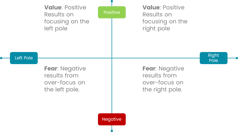 are many methods to identify operational friction. When this friction is identified, it can be placed on a tension map. Tension maps IDENTIFY the pros/cons of each side of the friction and help you prioritize CONCERNS.
 This
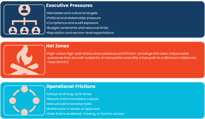 expands on business operational tension and includes the lens of executive PRESSURES. The result is identification of "hot zones" which are high-value, high-pain areas WHERE pressure AND friction CONVERGE into clear measurable outcomes.
AI DECISIONING - GOVERNANCE
For a small to medium-sized business, governance doesn't need to be a massive bureaucratic hurdle. It begins with a simple set of questions when implementing agentic AI that makes/informs business decisions.
- 🙍Who is responsible? Assign a specific team member to oversee the tool output. This provides ACCOUNTABILITY
- ❓What are the guardrails? Define the limits of what the AI can decide without a human review. This defines CONTROL.
- 🛡️How do we audit? Schedule a monthly or quarterly check to review the accuracy and ethical impact of the decisions made. This is the foundation of TRANSPARENCY.
Power Components
Priority Prompt: "pAIN POINT DISCOVERY"
- Act as an expert AI Strategist. Your goal is to help me identify high-value AI opportunities by uncovering my current business pain points.
Conduct a structured Q&A with me. Ask me one question at a time. Wait for my answer before moving to the next question. Focus on these four areas:
- Bottlenecks: Where is work currently stalled or waiting for manual approval?
- Repetition: Which tasks do my team members find most soul-crushing or repetitive?
- Information Gaps: Where are we making decisions based on "gut feel" because the data is too hard to organize?
-Customer Friction: Where do our customers or clients complain about speed or communication?
After 5 to 6 questions, summarize my answers into a "Pain Point Map" and suggest one specific AI tool or automation strategy for each.
Recommended Resource
Engagedly
AI-Powered HR Solutions That Actually Work Tell me more...