
 |
The AI Leader Building a smarter organization with modern tools and literacy |

From Assistants to Agents: The 2026 Mandate
The landscape of 2026 has transitioned from the era of experimentation into the era of outcomes. While previous years focused on what technology could do, this period is defined by what autonomous systems are doing independently. We have entered the age of Agentic AI: a state where digital tools no longer merely predict or draft, but execute complex tasks without constant human prompts.
For small and medium-sized business leaders, the competitive gap is widening between those who treat technology as a faster typewriter and those who treat it as a digital workforce. This shift manifests in three critical areas.
Customer Interactions: The Buyer Agent Economy - Search engines are becoming obsolete for many consumers. Customers now utilize personal buyer agents to find, vet, and purchase products. If your business data is not optimized for Answer Engines, your brand remains invisible to the modern consumer. Achievement of business parity requires your digital assets to be readable by machines, not just humans.
Operations: From Automation to Orchestration- Workflows have shifted from static, rules-based sequences to dynamic networks. Multi-agent ecosystems now manage entire processes, such as billing resolution and inventory planning, without waiting for human triggers. C.H. Robinson, for example, utilized its "Lean AI" agents in January 2026 to automate 95% of its missed freight pickup checks, recovering 350 hours of manual work every day. These systems communicate with one another to resolve internal trade-offs, allowing the business to operate at a velocity that manual processes cannot match.
People: The Redesign of Leadership - The role of the manager is undergoing a structural transformation. Routine oversight and reporting are now handled by autonomous systems, which flattens organizational hierarchies. ABF Freight demonstrates this shift through its city route optimization tools, which save the company $15 million annually by providing drivers with real-time, AI-driven navigation that adapts to congestion. Human leaders must move from performing the work to directing the intelligence. Success depends on the ability to set strategic guardrails for a hybrid workforce of humans and agents.
The 2026 AI Maturity Model
To lead effectively, you will need to first recognize your current baseline. Use this model to identify the milestones between basic tool usage and true autonomous capability.
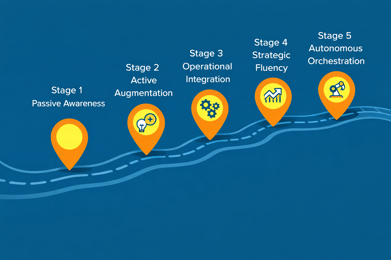 Stage 1: Passive Awareness - At this entry level, usage is fragmented and unauthorized. Employees utilize personal accounts to summarize long emails or draft basic documents. There is no central strategy, and data security is managed by individual discretion. The primary risk at this stage is data leakage and the creation of intellectual silos where no two team members use consistent logic.
Stage 2: Active Augmentation - The business officially sanctions specific tools to increase speed. Teams use large language models for specialized tasks like coding assistance or marketing copy. While individual output increases, the organization faces a speed bottleneck because legacy manual approval processes cannot keep up with the volume of generated material. Efficiency gains are often lost in the review cycle.
Stage 3: Operational Integration - This is the inflection point where technology connects to your proprietary data. Instead of merely interacting with a model, you integrate it with your CRM, inventory, or project management systems. Your workflows shift to a "human-on-the-loop" oversight model. The agents trigger actions, such as drafting a supply order when stock is low, while a human provides final approval rather than performing the data entry.
Stage 4: Strategic Fluency - Literacy becomes a core competency across the entire company. Every department possesses the skills to prompt, verify, and govern their own digital assets. Leadership hires for orchestration skills rather than technical execution. At this stage, the business realizes measurable revenue acceleration because the organization can make data-backed decisions faster than the competition.
Stage 5: Autonomous Orchestration - The business operates as an AI-native entity. At this peak, autonomous agents function as a new class of digital employee. You deploy ecosystems of these agents to manage entire objectives with minimal intervention. Garfield AI serves as a practical example: as an SRA-regulated firm, it recovers outstanding debts for businesses in minutes at a cost of only a few pounds per claim. These digital team members communicate with one another to resolve trade-offs, manage budgets, and execute campaigns. Human leaders focus exclusively on ethical guardrails and high-stakes strategic pivots, creating a competitive moat that legacy firms cannot replicate.
Case Study: TruckHouse - TruckHouse, a Nevada-based manufacturer of expedition vehicles, serves as a clear example of an SMB that transitioned from Stage 2: Active Augmentation to Stage 3: Operational Integration.
➡️Initially, the team utilized AI for isolated tasks like drafting communications or basic problem-solving. This represented the Active Augmentation phase, where speed increased but remained siloed from core business logic.
➡️The business moved to Stage 3 by connecting Gemini directly to their proprietary inventory data within Google Sheets. This integration allows the model to analyze stock levels, track components, and assist in logistics planning. By anchoring the AI to their actual production data, they moved the staff into an oversight role. Employees now verify the AI-generated inventory insights rather than manually inputting and cross-referencing thousands of individual parts.
Where are you on this journey? Are you stuck in being the bottleneck, reviewing every AI output? What is your plan to move to the next level of AI maturity?
Start with the bottleneck
Do not start with more tools. Start with one bottleneck.
The fastest path to AI value is not a broad rollout. It is redesigning one business function that slows revenue, service, or cash flow.
Pick one recurring process where work stalls, such as quote turnaround, invoice review, customer follow-up, or inventory checks.
Connect AI to the data, rules, and policies your team already uses. Without context, AI drafts. With context, AI supports decisions.
Let AI handle the first pass. Let your team review exceptions, approve actions, and focus on judgment.
Search vs. Prompting
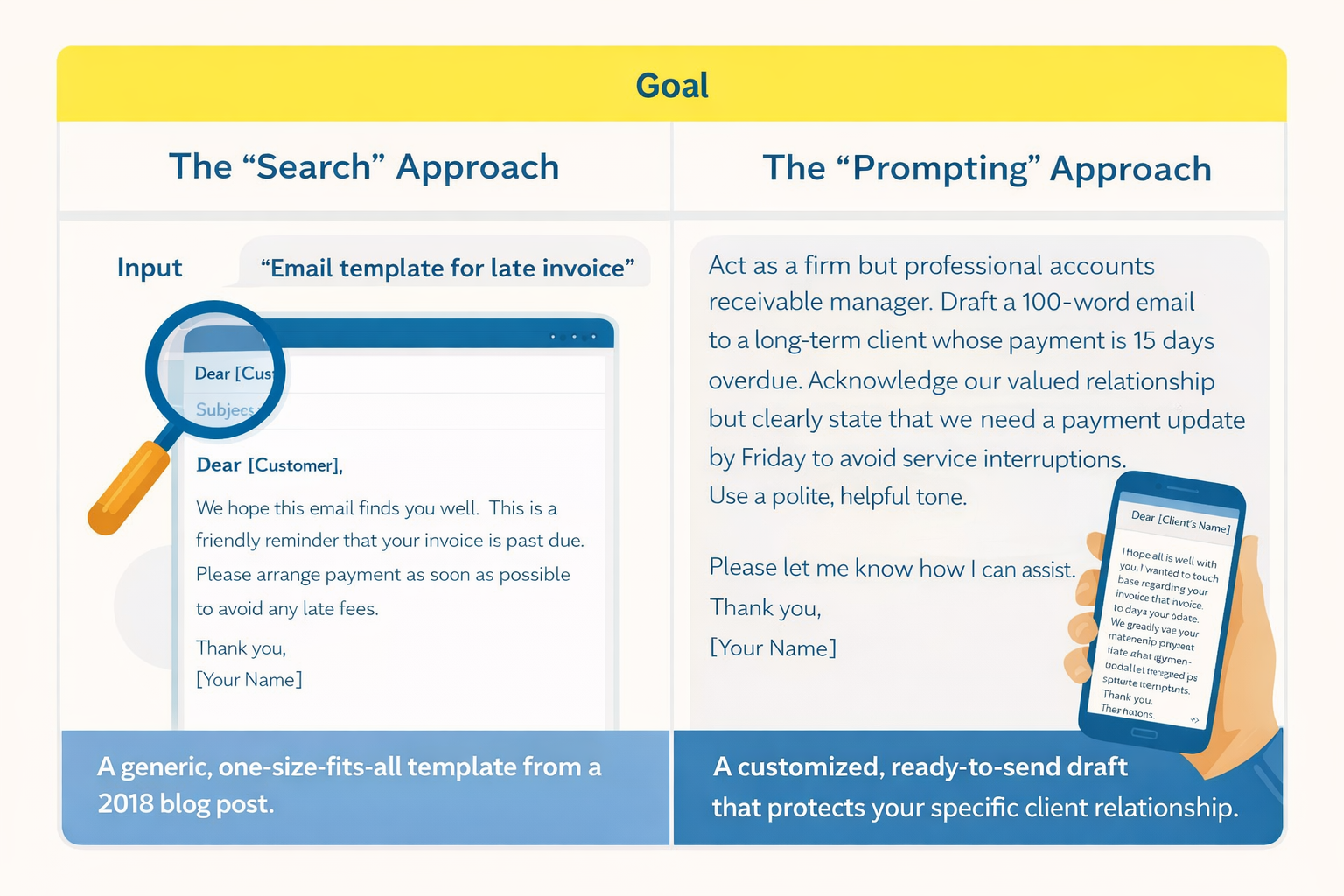
🔎When you search, you are looking for an existing destination. When you prompt, you are giving directions to build something new.
↗️Searching is for Retrieval: You provide keywords to find a specific document, a fact, or a website that already exists. Success is measured by how quickly you find the right link.
💫Prompting is for Synthesis: You provide context, constraints, and a goal to generate a unique output. Success is measured by how well you describe the desired result.
The Shift
To move from searching to prompting, you must stop using keywords and start using "intent."
| Feature | Search Engine Mindset | AI Prompting Mindset |
| Input Style | Short, fragmented keywords | Full sentences with clear context |
| Expected Goal | To find where information is stored | To create, summarize, or analyze |
| Control | You sort through what others wrote | You direct the AI on how to write |
The Commander Rule
Think of a search engine as a librarian and an AI as a capable assistant. You don't give a librarian a set of complex instructions on how to draft a memo; you just ask where the books on memos are. Conversely, you don't just say "memo" to an assistant and expect a finished product.
💡Semantic Clarity means recognizing that the quality of the AI's "reasoning" is a direct reflection of the clarity in your instructions.
Before and After
Here's an example of what your "search" looks like before AI and after you learn prompting techniques.
Why This Shift Matters
When you search, you are a consumer of information. When you prompt, you are a director of a reasoning engine.
▶️Search asks: "Where is the answer?"
▶️Prompting asks: "How should the answer be built?"
The "S.C.O.P.E." Checklist
To help your team move from keywords to instructions, use this simple fluency framework for every prompt:
Setting: Who is the AI (e.g., "Act as a marketing consultant")?
Context: What is the background (e.g., "We are a local HVAC company")?
Objective: What is the specific goal?
Parameters: What are the limits (e.g., "Keep it under 200 words")?
Examples: What does a "good" version look like?
The Result
By shifting to this mindset, you stop digging through search results and start generating high-value business assets in seconds. Fluency is knowing that the AI's "intelligence" is unlocked by the quality of your directions.
Power Components
Priority Prompt: "strategery"
Business Context: [Insert your industry, primary product/service, and current headcount]
Primary Goal: [Insert what you want to achieve in the next 6 months]
Current Obstacle: [Insert the biggest thing slowing you down]
Please provide:
- A 2x2 SWOT Analysis focused on my specific goal.
- Three 'Low-Hanging Fruit' actions I can implement this week for immediate impact.
- A 30-60-90 day roadmap to overcome my primary obstacle.
- A list of 5 AI-driven tools or automations that could specifically reduce my team's manual workload in this area.
Write in a professional, encouraging, and direct tone. Avoid jargon and focus on practical steps."
Recommended Resource
Acuvi InsightIQ
Turn Everyday Data into Strategic Insights Tell me more...





.png?width=352&name=New%20Website%20Instagram%20Post%20(8).png)