 |
The AI Leader Building a smarter organization with modern tools and literacy |

Legislative Guardrails (The Small Business AI Advancement Act)
The Small Business AI Advancement Act (H.R. 3679) is a critical piece of bipartisan legislation that passed the U.S. House of Representatives in February 2026. It is currently under consideration by the Senate Committee on Commerce, Science, and Transportation.
The core intent of the bill is to bridge the "adoption gap" by providing small businesses with the same level of strategic guidance that enterprise-level companies already possess.
Directs NIST to Build a "Main Street" AI Toolkit- The Act requires the Director of the National Institute of Standards and Technology (NIST) to create a suite of voluntary resources specifically for SMBs. Unlike general AI whitepapers, these must be:
- Technology-Neutral: Focused on business outcomes rather than pushing specific software vendors.
- Practical: Including real-world case studies, benchmarks, and implementation frameworks.
- Accessible: Designed for non-technical business owners to understand and use immediately.
Focus on Responsible Adoption & Document Intelligence-A major pillar of the bill involves helping small businesses manage the transition to Agentic AI. The resources will focus heavily on:
- Cybersecurity & Privacy: How to use AI without leaking proprietary "trusted information."
- Risk Mitigation: Guidance on how to avoid "automating mistakes" by ensuring data quality before deployment.
- Standards: Aligning small business practices with international AI standards to keep them competitive in global supply chains.
Integration with the SBA Network - To ensure these tools don't just sit on a federal website, the Act mandates a partnership with the Small Business Administration (SBA). This means that local Small Business Development Centers (SBDCs) and SCORE mentors will be trained to deliver this AI guidance directly to owners in their communities.
digital workers
Agentic AI marks a shift from tools that simply answer questions to systems that can plan and execute complex workflows. For small businesses, this represents a significant opportunity to scale operations without necessarily increasing headcount.
Here are the top three things SMB owners should understand as they look at this technology in 2026:
Most people are familiar with "Chat" AI that provides information. Agentic AI is different because it focuses on the action layer. Instead of just drafting a response to a customer inquiry, an AI agent can independently access your shipping database, check a carrier's API for a status update, and process a reroute for a package without a human needing to trigger each step.
For an SMB, this means your technology is no longer just a digital assistant; it is a digital worker capable of managing end-to-end tasks like bookkeeping, lead qualification, or complex meeting coordination.
The performance of any agent depends entirely on the quality and structure of the information it can access. In the world of agentic systems, what was once called "unstructured data" is now your most valuable asset: Document Intelligence.
Before deploying agents, you must ensure your business information is "trusted" and organized. An agent given the autonomy to make decisions based on outdated or messy files will simply automate mistakes at scale. Success begins with a clear strategy for how your information is stored and verified.
Adopting agentic AI does not mean "setting it and forgetting it." As agents gain more autonomy, your role as a business owner shifts from "doer" to scale operations without necessarily increasing headcount.
START SMALL: Begin with low-risk, internal workflows—like summarizing inbound requests, before moving to customer-facing or financial tasks
ESTABLISH GUARDRAILS: You must define clear boundaries for what the agent is allowed to do, such as setting a maximum refund amount it can authorize without human approval
MAINTAIN HUMAN-IN-THE-LOOP: High-impact outcomes should always include a checkpoint where a person verifies the agent's work to ensure quality and compliance.
Claude Secret Codes
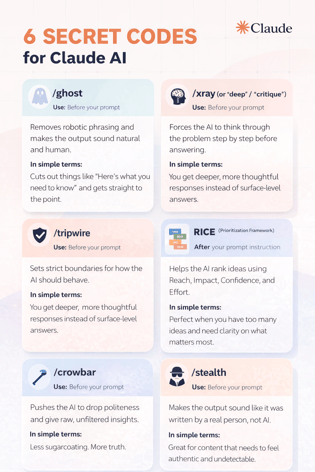
This infographic outlines six specific "slash commands" designed to modify how Claude AI processes information and delivers results. These commands act as behavioral presets that change the tone, depth, and structure of the output before the AI even begins drafting.
 The Six Commands
/ghost
Cuts out conversational filler like "Here is what you need to know" and gets straight to a natural, human-sounding point.
/xray
Encourages the AI to "think out loud" and analyze the problem deeply rather than giving a surface-level answer.
/tripwire
Establishes firm rules for the AI's behavior, ensuring it stays within specific constraints and remains focused.
RICE
Uses the Reach, Impact, Confidence, and Effort framework to rank numerous ideas based on their actual value and feasibility.
/crowbar
Pushes the AI to give raw, unfiltered insights and "un-sugarcoated" truths about a situation or document.
/stealth
Focuses on making the text feel lived-in and real, specifically designed to bypass the generic "AI feel."
From a leadership perspective, these codes represent a shift from simple prompting to orchestrated intelligence. By using these modifiers, a user ensures that the "trusted information" they receive is already formatted for its specific business purpose.
Whether you need the raw honesty of a /crowbar analysis for a project post-mortem or the refined, human-centric output of /ghost for a client email, these tools help align the technology with a specific strategic outcome.
Power Components
Priority Prompt: "tHE INTERVIEW"
- I want you to act as a Strategic Business Operations Consultant. I am a small business owner looking to [Insert Goal, e.g., automate my client onboarding].
Before we start, I want you to ask me 5 targeted questions about my current manual process, the tools I already use, and my definition of a successful outcome.
Once I answer, please provide:
1. A Business Process Translation of my manual steps into a digital workflow.
2. A list of 3 specific AI tools or Microsoft 365 features that can handle these steps.
Do you understand the role? If so, please ask the first 5 questions.
Recommended Resource
HEYGEN
ai Video generator TELL ME MORE...


.png?width=352&name=microsoft_machine_learning-removebg-preview%20(1).png)