Your team works hard. The process makes it harder.
Rework, waiting and steps nobody can explain eat time and margin every week. We map how work really moves, find the points where it stalls and redesign them with the people who do the work.
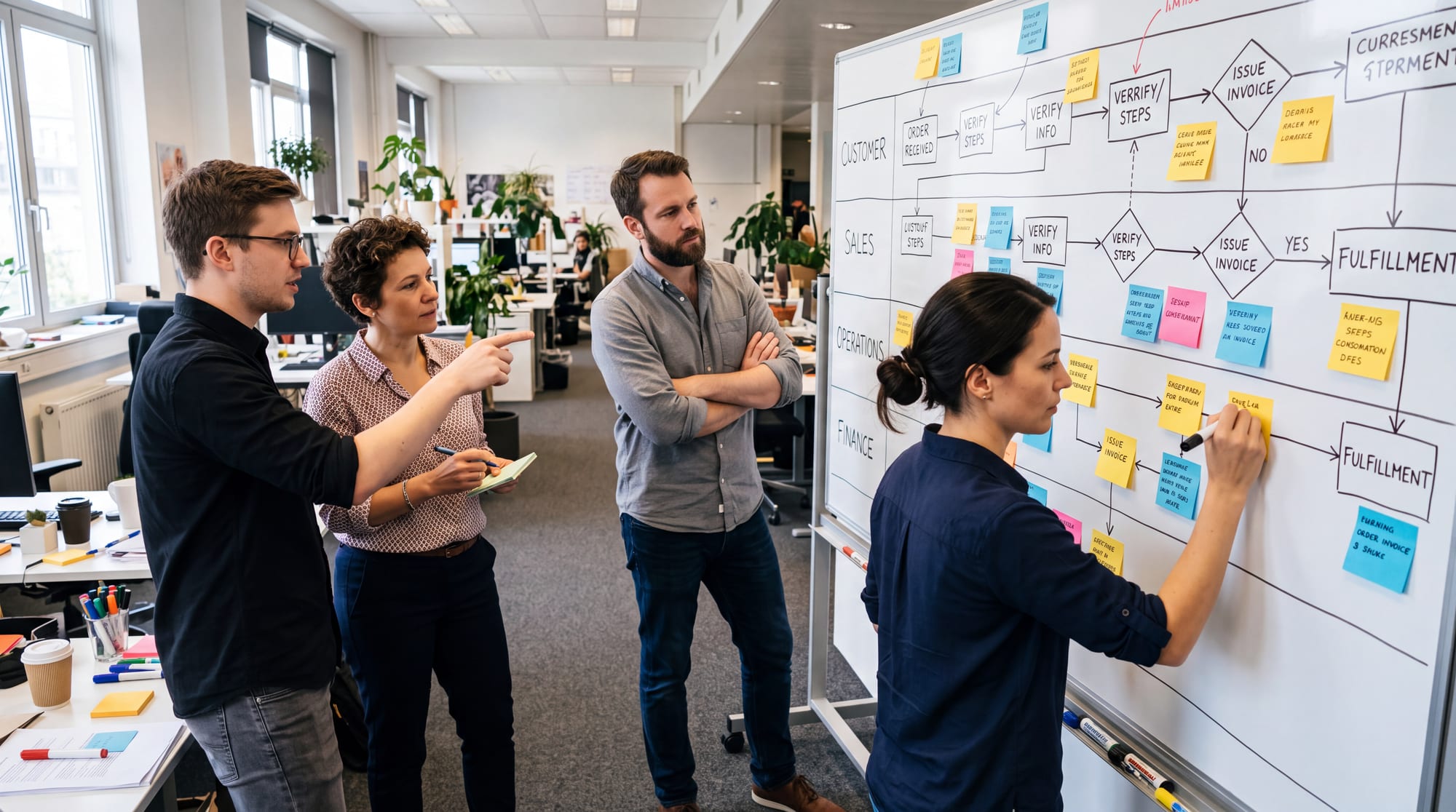
We follow the work, find where it stalls and redesign it with your team.
Origamic Solutions improves processes by following the work, not the documentation. We sit with the people who do it, map each step from request to result and measure where time is lost: waiting, rework, approvals and handoffs between people or departments. Most slow processes were never designed. They grew one workaround at a time, and the real cause is often a single step, an unclear owner or a missing standard. Once we can see it, we redesign the process with your team, test it on real work and document it so it holds when people change roles. If a tool or a data gap is the true source, we say so and fix it there instead. We work with growing businesses and state and local government agencies across Virginia and nationwide, using the IMPACT Methodology® so every change has a baseline, a measure and an owner.
What you see, and where it usually starts.
These feel like effort problems. Most of them are design problems.
Everything waits on one person.Usually starts in Process and People
Approvals and know-how pile up at one point in the flow. The work isn’t slow; it’s queued.
The same mistake keeps coming back.Usually starts in Process
Each fix patches the output instead of the step that produced it, so the error returns with the next batch.
Two teams do the same job two different ways.Usually starts in Process
There is no documented standard, so each team built its own. Quality depends on who picks up the work.
Projects launch with energy, then stall.Usually starts in Process and People
The plan was built for the kickoff, not for delivery. Nobody planned for the people, the dependencies or the second month.
Nobody can say how long anything takes.Usually starts in Data and Process
Work isn’t measured from request to result, so delays are invisible until a customer or constituent complains.
The new system made the process slower.Usually starts in Tools and Process
The tool was configured around the vendor’s default workflow instead of yours, so your team added steps to make it fit.
How we work on process.
Follow the work end to end
We map each step as it really happens, with the people who do it. You see where time and money actually go.
Find the step that causes the rest
Most delays trace back to one or two points: an approval, a handoff, a missing standard. We find those first.
Redesign it with your team
The new process is built and tested on real work with the people who will run it, so it fits on day one.
Measure it and hand it over
A baseline, a measure and an owner for every change, documented so it holds when people move on.
Process services.
Design the process right, then make sure it survives delivery.
Implementation Strategy and Support
Plans that hold up in execution, with support through delivery.
Solution Design and Performance Improvement
Map how work really flows and redesign what isn’t working.
When it isn’t really a process problem.
People, process, tools and data hold each other up. A problem in one usually shows up in another, so we look at all four before we fix any of them.
People
A sound process still fails when nobody owns it or the team was never brought along. That starts with people.
Tools
When the system forces extra steps, redesigning on paper won’t help. That is a tools problem.
Data
If you can’t measure the process, you can’t tell whether a change worked. That is a data problem.
Questions about process
Show us where the work gets stuck.
Bring the process that frustrates you most. We’ll ask how it really runs, and tell you honestly where we think the time is going.
Not ready to talk yet? Take the 8-minute Business Health Check.